
PraxisCounsel & Consult
Sønderborg | København

What We Do
Praxis provides reflective counselling and institutional consulting that support clarity and careful judgment for individuals and organizations navigating uncertainty, difficulty, and change.
Counsel
Counselling at Praxis supports adults facing periods of strain, emptiness, uncertainty, or difficult life transitions. The work is reflective and non-pathologizing, emphasizing personal values, clarity, meaning, and thoughtful decision-making rather than diagnosis or clinical treatment.The approach draws on established social-psychological methods within a broader existential perspective. It offers a structured space for individuals who wish to reflect, reorient, and engage more deliberately with their lives and circumstances.
Consult
Consulting at Praxis supports organizations working through complex human and organizational challenges, particularly during periods of pressure, change, or institutional reorientation. The work focuses on understanding context, relationships, and institutional dynamics rather than providing narrow technical fixes.This work draws on organizational psychology and social theory and is intended for institutions seeking to examine questions of effectiveness, culture, responsibility, and practices within their everyday operations.

Counselling at Praxis
Who We Counsel
This counselling work is for adults who are still functioning, but feel increasingly strained, stuck, disconnected, or uncertain about how to move forward.Common reasons people reach out include work-related stress, difficult decisions, relationship strain, life or career transitions, loneliness, loss of meaning, or ongoing recovery support.This work may be a good fit if you prefer thoughtful conversation over quick advice or fixed techniques. Sessions offer space to slow down, understand what is happening more clearly, and consider how you want to respond. It is a space that will allow you to holistically consider your life and the on-going challenges you might be facing while remaining focused on pragmatic, ethical, and meaningful ways to help you adapt and grow.Many clients are professionals, internationals, or English-speaking residents navigating personal, cultural, recovery-related, or work-related complexity. Danish clients who are comfortable working in English are also very welcome.
How the Work Is Structured
Sessions are conversational and collaborative. The work is informed by existential psychology and philosophy, with attention to meaning, responsibility, freedom, and limitation as they appear in ordinary life.Rather than following a fixed program, sessions develop in response to the concerns brought into the room and the patterns that emerge through discussion.Counselling may draw on several psychological frameworks, including:* Acceptance and Commitment Therapy (ACT)
Used to clarify values and support more flexible responses to difficult thoughts and emotions.* Rational Emotive Behavior Therapy (REBT)
Used to examine how beliefs and interpretations shape experience, emotion, and action.* Transactional Analysis
Used to explore recurring relational patterns, roles, and expectations.These approaches are used pragmatically as working tools, not fixed protocols. They are integrated according to the needs of the conversation and the questions that develop over time.Session Lengths* Individual sessions: 50 minutes
* Couples sessions: 90 minutes
* Group sessions: 90 minutes
What to Expect
Counselling at Praxis is deliberate and steady in pace. Early sessions focus on clarifying what brings you to the work, how you understand your situation, and what feels most significant in the questions you are facing.Over time, conversations may explore recurring patterns in thinking, behavior, and relationships, along with the commitments and priorities that guide your decisions. Attention is given to both immediate concerns and the wider circumstances in which they develop.Progress in this form of counselling is rarely linear. Insight and change usually emerge gradually through sustained conversation rather than through prescribed techniques or short-term solutions.
Scope, Role, and Limits
Counselling at Praxis is offered within a reflective, non-clinical framework. It does not replace medical, psychiatric, or emergency mental health care. This practice does not provide diagnosis, psychological testing, clinical treatment, crisis intervention, or emergency services. The work offered here is complementary to clinical care.The practitioner is not a licensed psychologist or psychiatrist. Counselling is provided by a US-trained social worker and social scientist and focuses on dialogue and careful engagement with life circumstances rather than clinical intervention.Information about the practitioner’s background, training, and experience can be found in the About Me section.Counselling is conducted in English, which serves as the working language of the practice. Services are available to both international clients and Danish clients who are comfortable working in English.If it becomes clear that different or additional forms of support are needed, this will be discussed, and appropriate referrals will be encouraged.

Consulting by Praxis
Our Orientation
Praxis works with organizations operating in increasingly digital, accelerated, and performance-driven environments that want to reintroduce human considerations into everyday operational and strategic decisions.The work supports institutions in clarifying shared values, responsibilities, and expectations while developing a clearer understanding of how people experience their roles, demands, and constraints. Rather than separating human concerns from strategy or operations, Praxis helps organizations account for psychological and social realities in how work is structured, managed, and carried out.The aim is to support adaptation to market and institutional pressures in ways that remain sustainable for both the organization and the people whose work makes it possible.
Who We Serve
Consulting by Praxis is intended for organizations experiencing human or organizational strain that existing systems, policies, or technical adjustments have not resolved. This includes public institutions, educational environments, nonprofits, mission-driven organizations, and professional teams working under sustained pressure or institutional complexity.Organizations often seek this work when challenges such as employee burnout, disengagement, moral strain, role ambiguity, and/or communication breakdowns are present while the underlying dynamics remain difficult to identify or address responsibly. The work supports institutions that want a clearer understanding of what is unfolding in practice and how to respond without introducing further fragmentation or symbolic change.
Custom-Tailored Service Tracks
Praxis offers consulting and support through three core service tracks. These can be engaged independently or combined, depending on an organization’s current needs.Some institutions begin with analysis because a shared understanding of the situation is lacking. Others already have evaluations or recommendations but find it difficult to translate insight into practice. In some cases, staff require immediate, embedded support during periods of sustained pressure. The service tracks are structured to address these different starting points.
Track One - Research and Analyses
This track supports organizations that recognize something is not functioning well but lack a clear, shared account of why. The focus is on examining how institutional structures, cultures, roles, and everyday practices shape behavior, decision-making, and working conditions.The work draws on organizational psychology, social theory, and applied qualitative methods and may include:• Exploratory interviews or facilitated conversations
• Qualitative analysis of work practices and organizational experience
• Review of policies, procedures, and institutional materials
• Research-informed evaluation of existing programs or initiativesThe aim is to develop a shared understanding that links human experience with organizational design, responsibility, and constraint, providing a grounded basis for future decisions.
Track Two - Translating Research and Evaluation into Practice
Many organizations already have evaluations, research findings, or recommendations but find it difficult to translate them into sustained change. Track Two focuses on bringing these insights into practice through implementation, training, and advisory support.The work draws on organizational psychology to support learning, role clarity, and adaptive practice, while remaining attentive to institutional realities, including capacity, mandate, and culture.Activities may include:• Facilitated workshops or reflective training sessions
• Advisory support for leadership or project teams
• Support for implementing revised practices or frameworks
• Ongoing training during periods of organizational changeThe emphasis is on thoughtful adjustment and lasting organizational learning rather than rapid transformation or standardized change models.
Track Three - In-House Mental Wellness Support
Some organizations experience ongoing staff strain that cannot be adequately addressed through HR processes, external consultants, or clinical services alone. Track Three provides embedded, non-clinical mental health support for institutions seeking accessible, psychologically informed support within everyday working environments.In-house support may include:• On-site or embedded reflective coaching and couselling support for staff
• Individual or small-group conversations addressing work-related strain and role pressure
• Support for teams working in high-pressure or ethically complex environmentsThis work is intended to complement, not replace, external clinical services or employee assistance programs. Its aim is to support early response and stabilization before strain develops into crisis, disengagement, or staff attrition.
What to Expect
Consulting engagements typically begin with exploratory conversations to clarify the organization’s situation, the questions that are emerging, and where existing approaches are no longer sufficient. From there, the work develops collaboratively, with attention to institutional responsibilities, psychological realities, and operational constraints.Some engagements remain focused within a single service track, while others move gradually from analysis into implementation, advisory support, or embedded staff support. Throughout, the emphasis is on developing a clear understanding and supporting responsible action under real-world conditions.Organizations may select a single track or combine several depending on their circumstances. The aim is to strengthen how the organization functions in practice, supporting both institutional goals and the people responsible for carrying out the work.
Scope, Role, and Limits
Consulting and in-house mental health support provided by Praxis do not involve clinical services, diagnosis, or individual psychotherapy. The work is advisory and analytical in nature, oriented toward institutional understanding and psychologically informed practice rather than compliance processes, performance management, or therapeutic treatment.All services are provided by a social worker and social scientist with training and experience in peer-reviewed research, organizational psychology, institutional analysis, and applied support work. Information about professional background, training, and experience is available in the About Me section.Consulting engagements and in-house support are conducted in English. Services are available to Danish institutions and international organizations that are comfortable working in English.
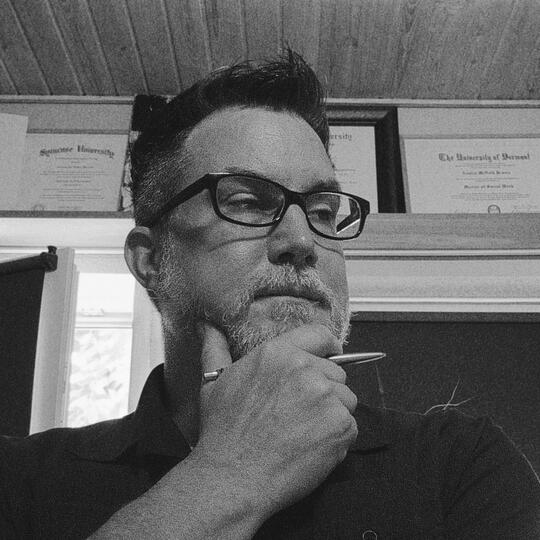
Austin McNeill BrownMSW|PhD
My Story
First and foremost, I am a person in long-term recovery from substance use disorder, an international living in Denmark, and a practitioner with a background in psychology, clinical social work, and social science. I hold a BA in Psychology, an MSW with a clinical focus, and a PhD in Social Science from the Maxwell School of Citizenship and Public Affairs at Syracuse University.Before relocating to Denmark, I spent many years working in clinical, institutional, and academic settings in the United States, including as a clinical social worker, researcher, and program leader.Over time, my work moved beyond clinical practice alone toward broader questions about the social, organizational, and cultural conditions that shape people’s lives, work, and sense of meaning. Praxis grew from this perspective: a counselling, consulting, and research-informed practice focused on human experience within contemporary social and institutional life.
An Interdisciplinary Background
My work draws on psychology, clinical social work, social science, and organizational inquiry. Across these fields, I focus on how individual experience is shaped by social context, institutions, and wider economic and political conditions.My approach is informed by existential philosophy and psychology, especially their attention to meaning, responsibility, freedom, and limitation. I also draw on critical social theory, organizational theory, and political economy to understand how institutions, digital systems, incentives, and market pressures shape everyday life.Together, these perspectives support work that is psychologically informed, socially grounded, and attentive to the conditions in which people and organizations operate.
Brief Bio
I am a social worker and social scientist with more than a decade of experience spanning research, clinical practice, community, and institutional work. I hold a PhD in Social Science from the Maxwell School of Citizenship and Public Affairs at Syracuse University, an MSW from the University of Vermont, and a bachelor’s degree in psychology from Texas Tech University.Since 2014, my work has included counselling within social work settings, applied research, and the direction and coordination of student support and recovery-oriented organizations. Since 2017, I have also provided consulting and advisory support to institutions working at the intersection of mental health, organizational practice, and policy.My professional experience spans academic research, applied social work, organizational leadership, and consulting across universities, public institutions, and nonprofit organizations.A full CV is available upon request.
Publications and Research
My publications span social science, recovery and addiction research, ethnography, and institutional analysis. Across more than two dozen peer-reviewed articles, this work examines how individual experience is shaped by social structures, institutional arrangements, language, and political-economic conditions.Much of my research has contributed to recovery science, including work on recovery capital, identity transformation, and peer-based recovery support. My scholarship also includes qualitative and genealogical studies of subjectivity, culture, power, and the social production of meaning.
Selected Works
Ashford, R. D., Brown, A. M., Curtis, B., et al. (2018).
Substance use, recovery, and linguistics: The impact of word choice on explicit and implicit bias. Drug and Alcohol Dependence.Brown, A. M., Ashford, R. D., & Figley, N. (2019).
Alumni characteristics of collegiate recovery programs: A national survey. Alcoholism Treatment Quarterly.Ashford, R. D., Brown, A. M., Ryding, R., et al. (2020).
Building recovery-ready communities: The recovery-ready ecosystem model and community framework. Addiction Research and Theory.Ashford, R. D., Brown, A.M., Canode, B., Sledd, A., Potter, J. S., & Bergman, B. G. (2021).
Peer-based recovery support services delivered at recovery community organizations: Predictors of improvements in individual recovery capital. Addictive Behaviors.Zhang, X., Brown, A. M., & Rhubart, D. C. (2023).
Can resilience buffer the effects of loneliness on mental distress among working-age adults in the United States during the COVID-19 pandemic? International Journal of Behavioral Medicine.McNeill Brown, A. (2023).
Suburban subjectivities: A genealogical account of the American dreamscape. Doctoral dissertation, Syracuse University.
A full listing of all my research can be found here on Google Scholar.
Rates and Service Delivery
Counselling
SessionsCounselling at Praxis is offered with attention to accessibility, convenience, and fairness. When possible, fees are adjusted through a sliding scale that takes individual circumstances into account.Current counselling formats include:* Single Sessions
Individual sessions focused on reflection, orientation, and thoughtful decision-making.* Couples Sessions
Sessions supporting shared reflection, communication, and greater understanding within relationships.* Group Sessions
Small group sessions organized around shared themes, such as work-related strain, life transitions, or collective reflection.
SettingsCounselling may be provided in the following formats:* Office-Based Sessions
Sessions held in a private office setting.* Mobile In-Person Sessions
In-person sessions at an agreed location. Available by arrangement, with a small additional fee depending on distance and scheduling.* Online Sessions
Sessions conducted online. Offered at a reduced rate.
PaymentCounselling services at Praxis are privately provided.* Private Payment
Sessions are not covered by the Danish public health system or public insurance schemes.* Timely Access
This work is intended to complement existing services by offering timely access to reflective counselling when other options may be limited or delayed.* Transparent Fees
Fees are discussed during initial contact and may be adjusted where appropriate to take individual financial circumstances into account.
Consultation
Consulting engagements and in-house mental health support are priced by project rather than by a fixed hourly rate. Organizations are invited to make contact to discuss scope, duration, and context so that an appropriate proposal can be developed.Fees are determined with attention to:• the nature and scale of the engagement
• expected time commitment and level of on-site presence
• institutional context and organizational capacityConsulting work may be delivered on site, remotely, or through a hybrid arrangement depending on organizational needs.A detailed proposal outlining the scope of work and itemized pricing is provided following initial discussions.
Ready to Get Started?
Start with Just an EmailReaching out does not require a fully formed plan. You are welcome to send a brief message if you are considering counselling, consulting, or in-house support.For counselling, it is completely normal to feel unsure about what to say or whether your concerns are “clear enough.” The first conversation is simply an opportunity to understand what is happening, what kind of support may be useful, and whether Praxis feels like the right fit.Initial communication is handled through secure Proton Mail, and all correspondence is treated as confidential.Please use the Contact page to send a short inquiry with your name, what you are looking for, and how you would like to be contacted.
Contact
We provide services throughout Denmark with a specific focus on Sønderjylland and the Capital Region. However, we can offer service to anyone in Denmark. We are based in Sønderborg.
Confidential and secure email (encrypted): [email protected]